Philosophy in Form, Brand in Practice
昨天的茶道課,我問老師:「您在這條茶路上,最在乎或追求的是什麼呢?」
老師毫不猶豫地說:「精神上的滿足。」
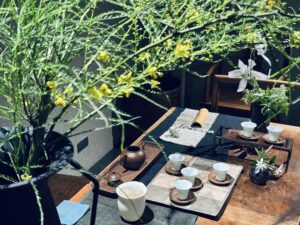
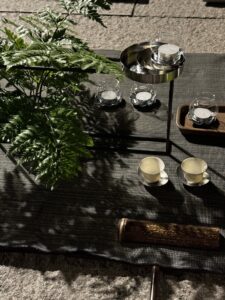
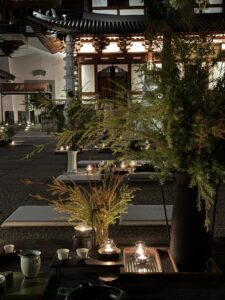
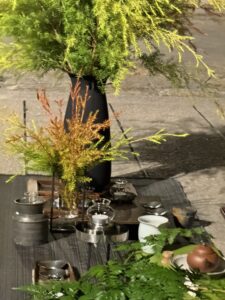
這個答案像是靜靜落下一句話,沒有高調鋪陳,卻很難不被觸動。在茶席之上,我們常常講究每一件物的搭配——茶壺、茶盅、茶巾、擺件,每一樣都可以講究到極致,甚至為了呈現理想的美感與氛圍,反覆練習、調整與思考。
但老師接著說,這樣的講究不是為了形式,而是為了回到一個更深的思考,那就是——「道器一體」。
這句話出自《易傳》:「形而上者謂之道,形而下者謂之器。」
道,是精神,是看不見但可以感受到的本質。
器,是形式,是可見可用的外在工具。
真正的茶道,不是只追求器的精美,也不是只沉醉於道的空談,而是在兩者之間找到一種自然的融合。
一場茶席,從選茶、注水、出湯,到器物搭配、擺設秩序,每一個環節看似平凡,其實都是茶主人對於「此刻」的理解與選擇。它不會完美,卻總是誠實。因為在那個當下,你所做出的每個判斷,都是你內在狀態的具現。
茶道不是一場表演,而是一場對話。
你不是為了別人而準備這一泡茶,而是為了在其中看清自己——
我為何這樣選擇?我期待怎樣的回應?我有沒有尊重這一次的時間與關係?
學一天,有學一天的領悟;學三十年,依然能學出新的自己。
這樣的學習,正是令人著迷之處。
回到我們所熟悉的設計與品牌,其實道理也不遠。
設計看似處理的是「器」——logo、包裝、空間、文案;
品牌看似追求的是「道」——價值、理念、文化、風格。
但若只談器,就會空有形式、少了靈魂;
若只講道,卻無法落實於細節,也終究難以傳遞。
品牌的誕生、經營與實踐,也如茶道一般,是一場關於道與器的對話。
而每一次提案、每一次調整、每一次落地,不過是我們作為品牌設計者的「泡茶之舉」。
不是為了呈現一場漂亮的秀,而是為了讓每個品牌在它自己的節奏裡,自然而然長成它該長的樣子。
就像老師說的,精神上的滿足,是我們在這條路上持續學習與給出的心意。
我們相信品牌的形,最終會回到品牌的心。
而我們的設計,正是在這之間,慢慢泡出來的。
In Tea, We Learn Design—and the Art of Brand
During yesterday’s tea ceremony class, I asked my teacher,
“What matters most to you on this path of tea?”
Without hesitation, she replied,
“Spiritual fulfillment.”
That answer fell like a gentle sentence—quiet, unadorned, yet deeply resonant.
In the tea room, we often pay close attention to every element on the table:
the teapot, the cups, the cloth, the placement of each piece.
Every detail can be refined to the highest level.
To present the ideal atmosphere and beauty, we practice, adjust, and reflect over and over again.
But my teacher went on to explain that this pursuit of perfection is not about appearances.
It brings us back to something deeper—a principle known as “The unity of Tao and Vessel.”
This idea comes from the ancient Chinese text The Book of Changes (I Ching):
“What is above form is called Tao. What is within form is called vessel. Tao and vessel are one.”
Tao is the unseen—spirit, intention, essence.
Vessel is the visible—form, tools, expression.
True tea practice isn’t merely about refining the vessel,
nor is it just abstract pursuit of the Tao.
It’s about finding a natural unity between the two.
Every tea session—from the choice of leaves, the pour of the water, the harmony of the tools—
is shaped by how the host understands that moment.
It won’t be perfect, but it will be honest.
Because every decision made reflects the state of one’s inner self.
Tea is not a performance. It is a conversation.
You’re not preparing tea for others to be impressed—
you’re preparing it to see yourself more clearly.
Why did I choose this?
What kind of response do I hope for?
Am I respecting the time and the connection in front of me?
Whether you’ve studied for one day or thirty years,
there’s always something new to learn about yourself.
That, perhaps, is what makes the journey so captivating.
And when we return to what we do—design and branding—
we realize the same principle applies.
Design, at first glance, deals with the vessel:
the logo, the packaging, the space, the words.
Branding pursues the Tao:
values, culture, meaning, attitude.
If we focus only on vessel, the work becomes hollow.
If we chase only the Tao, it risks losing clarity in practice.
Building a brand, running a business, creating meaning—these are, too, conversations between Tao and vessel.
Each proposal, each revision, each real-world implementation—
they’re our versions of making tea.
Not to present a perfect show,
but to let each brand grow in its own rhythm,
to become what it is meant to become.
Just as the teacher said,
spiritual fulfillment is the reason we continue to learn, to refine, and to give.
We believe form will always return to heart.
And our design exists—quietly, attentively—somewhere in between.